
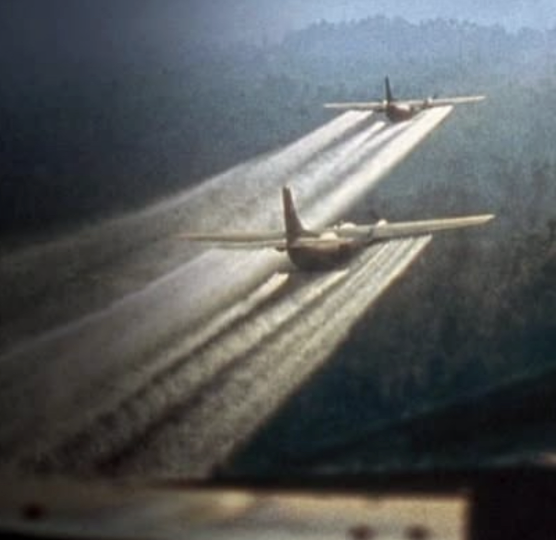
Decades after the Vietnam War ended, the effects of the military chemical Agent Orange are still troublesome to Vietnamese citizens and the environment across Vietnam.
Between 1961 and 1971, The United States military sprayed millions of gallons of Agent Orange across Vietnam as part of the program known as Operation Ranch Hand. The chemical herbicide was used to destroy forests and crops that were believed to have enemy forces hidden. The powerful chemicals in Agent Orange also contaminated the soil, water, and wildlife throughout the region.
“Quantities of Agent Orange were used for defoliation of military base perimeters; 9% of the total was used to destroy “unfriendly” crops as a means of reducing enemy food supplies,” Steven Stellman said, according to The National Library of Medicine.
Agent Orange contains a highly toxic compound known as dioxin, which can linger in environments for decades. The contamination continues to affect farmland and rivers, which makes it difficult for some communities to safely grow food or access clean water. Environmental damages caused by Agent Orange have also taken a toll on Vietnam’s ecosystems. Large sections of forests were destroyed by the spraying campaign, and certain areas have struggled to fully recover.
“Long-term exposure to Agent Orange may result in changes in susceptibility of local, particularly endemic species to other major stressors for biodiversity loss such as land use, fragmented habitats, agriculture, industrial, and urbanization development and climate change; which may collapse entire hyperdiverse tropical ecosystems,” Dr. Kiem N. Truong, lecturer of ecology at Vietnam National University said, according to The National Center for Biotechnology Information.
The health impacts have also been a severe issue for the Vietnamese citizens. Many people who were exposed to Agent Orange developed illnesses such as cancer, birth defects, and other long-term medical conditions. Thousands of cases have also been present in American Veterans who had dropped and been exposed to the chemical. In many scenarios, the effects have been passed down to children and grandchildren who were never directly exposed to the chemical.
“Dioxin is a highly toxic and persistent organic pollutant linked to cancers, diabetes, birth defects and other disabilities. The Red Cross estimates that three million Vietnamese have been affected by dioxin, including at least 150,000 children born with serious birth defects,” Peter Chenevey said, according to The Aspen Institute.
Efforts to clean up contaminated land have been in effect for years. Government and international organizations have worked together to remove the polluted soil and reduce the spread of dioxin in heavily affected areas. Even with all the efforts, experts say the clean up process is slow and expensive.
While the war officially ended in 1975, the consequences of Agent Orange remain part of everyday life for many Vietnamese families. For communities who live in the contaminated regions, the effects of the chemical continue to shape their health, environment, and future generations.